
What an AI slot game generator should do with one prompt
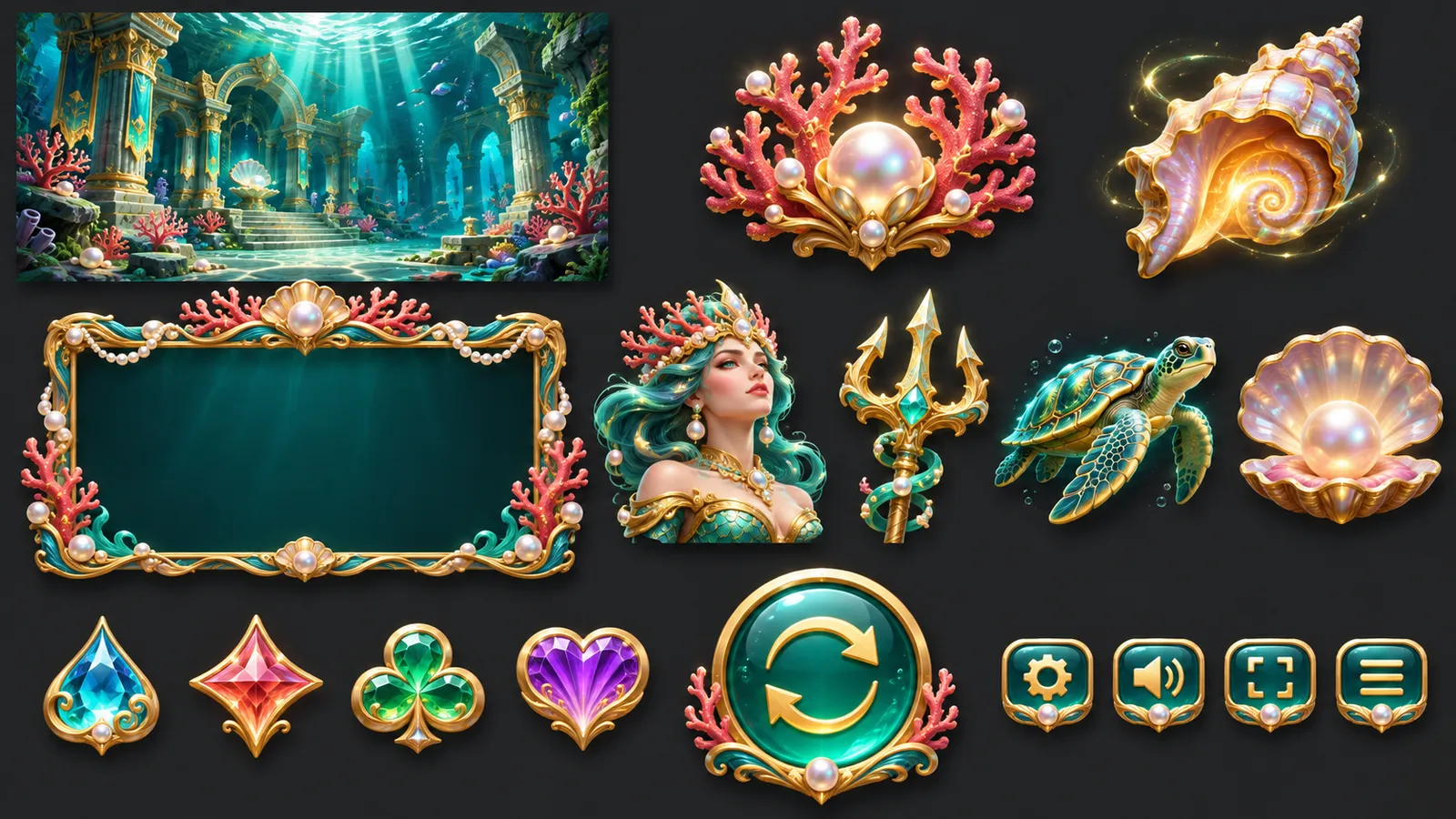
What you need back from one prompt
Ask a general image model for "an Egyptian slot game" and you get one picture: a pharaoh, some painted reels, gold on everything. It can look great. You can't ship any of it. The symbols are painted into the reels, nothing is on transparency, and when you ask for the Scatter on its own it comes back in a different style.
A slot needs about ten reel symbols in fixed roles, each one alone on a transparent canvas. It needs a cabinet for the reels, a 1920×1080 desktop stage and a separate phone stage, a title, a mascot, buttons and win art. And it needs a record of where every piece goes. That package is what Slot Art Generator builds from a brief. The slot game assets checklist lists every file.
It doesn't write game maths or an engine. It makes the art, then spins it for you in a five-reel preview.
What you type
Two fields are required: a game name and one sentence of theme. Say "Pharaoh's Gold" and "a flooded tomb under the Nile, lit by oil lamps". The rest is optional: palette, one of five style presets (premium 3D unless you change it), a named Wild and Scatter, high and low tier subjects, the mascot, background direction, and one extra note that rides on every asset.
There's no theme library behind the form. Subjects come from your words, and the game name counts, so "Pharaoh's Gold" already gives the run a pharaoh and gold to work with. Before anything is spent the form shows each subject, marked as named by you or derived, plus how many files the set will ship. If a derived subject looks weak, fix it there. Writing a slot art prompt covers what to put in.
The order things get drawn in
Order does more for consistency than any single prompt. Each step is conditioned on the ones before it.
- The brief is compiled into a numeric style contract: one key light from the upper left at 35 degrees, three value bands plus one specular cluster, a named list of materials and a 60/30/10 colour split. Every object prompt carries it word for word. Each symbol's prompt also excludes every other symbol's subject, so the scarab doesn't turn up on the ankh.
- A style board. It's a 3×3 chart of swatches, lit spheres and material chips with no subject in it. With the palette left blank, this is where the three colours get chosen.
- The Wild, before any other symbol. It becomes the master that sets the value range and detail level for the rest.
- The mascot, as one full-height figure at 1:3. Its reel symbol is cropped from that figure so both share a face. You can pause the run here and approve the foundation first.
- Every remaining symbol, card ranks included, each generated once against the board and the Wild.
- One cabinet at 11:7 that serves both stages. Code measures where the model actually put the reel opening and snaps it to 5:3.
- An empty plaque for the Wild, the Scatter and each high pay, keyed onto that symbol's own 512×512 canvas. Then one corner ornament, mirrored into all four corners.
- A 1920×1080 landscape, a 768×1366 phone stage that redraws the same place for a vertical camera (a crop of the landscape would cut the scene in half), and a 1200×400 title spelling the game name.
- The UI and packs: spin plus four secondary buttons, a HUD bar, a value plate, a progress track, a paytable panel, win art, bonus art, environment props and mascot states.
A full brief from one of the form's templates plans 48 generated images. There's no progress screen to sit on. The project card shows how far the run has got, and closing the tab mid-run is fine.
The jobs we took away from the model
A prompt can't promise a margin, a clean alpha edge or two greens that match. So code does those jobs after generation, the same way every time:
- It removes the backdrop, leaving each symbol as one object on transparency.
- It frames each symbol to an exact fill: 80% of the canvas for Wild and Scatter, 76% for high pays, 70% for low pays. Skip this and one output fills its canvas edge to edge while the next floats at half size, and the reels look like two games.
- It pulls colour toward the set's own anchors in LAB space, moving chroma and keeping lightness so the form survives.
- It fits the cabinet, measures the opening and mirrors the corner.
- It derives hover, pressed and disabled states from each idle button, and optional glow, shadow, outline and rim layers from each symbol's alpha.
- It composes loading splashes and lobby art from the finished files, with no extra generation.
Why each of those exists is in keeping an AI slot set consistent.
Spinning it before you download
A finished set opens as a five-reel, three-row game built from its own PNGs, placed at the rectangles in the manifest. It plays through the set's own buttons. You can flip between the desktop and phone stages without a reload, and three Scatters relight the stage into its bonus background.
The paytable is derived from the symbol tiers, so it isn't a maths model. It's there so you see the art moving. Some problems only show up in motion: two high pays that blur into the same orange blob, a Scatter you can't spot on reel five. Opening and spinning a set costs nothing, and the showcase has finished ones to try.
What's in the ZIP
Every PNG, a composited preview per stage, and asset-set.json. The manifest records each file's role, tier and size, and per stage the reel window, title slot, mascot slot, corner flips and nine-slice insets for the wide plates. Your developer places assets from those numbers instead of measuring a mockup by eye. Exact canvases are in the slot art specifications.
Redrawing one asset
Any generated asset can be redrawn with a note for that asset only, like "less gold on the scarab" or "thicker strokes on the 10". The redraw arrives as a candidate next to the current image. The accepted set, its ZIP and the preview stay put until you accept. Reject it and nothing changed. Each attempt uses one redraw credit, a failed attempt is refunded, and the last ten versions of every asset are kept so you can go back for free.
Where it stops
It won't make up a cast. A thin theme gives you a smaller set, or the form asks for more names. Derived subjects can be weak, so look at them before you generate.
It can't save a bad silhouette. Post-processing fixes size, alpha and colour. A symbol that's a muddy shape needs a redraw.
It doesn't grade your art either. Assets are measured once for internal diagnostics and nothing gets redrawn on its own. Only a redraw you ask for replaces an image.
Fallbacks are plain. If moderation keeps refusing the title, you get a composed wordmark that still spells the name right. The cabinet has no fallback: refused twice, the reels sit on a nominal window with no frame, and the run tells you so.
Production maths, certification, animation and product-specific screens are still your team's job. So is clearing any protected character, logo or brand you put in a prompt.
Price
One game is $19 with ten redraws. Three games are $49, and bigger orders cost less per game. 100 extra redraws are $10. You pay in crypto, there's no subscription and nothing is billed per image. Current offers are on the pricing page.
Questions
- What is an AI slot game generator?
- A tool that turns a written description of a slot into its art: reel symbols, cabinet, backgrounds, title, mascot and UI hardware. Slot Art Generator takes a game name and one theme sentence and returns a matched set of PNGs, a placement manifest and a playable preview built from them.
- Does it make a playable slot game?
- It makes the art, then plays it in a five-reel preview so you can judge it moving. It doesn't produce game maths, a real-money engine, certification or the product screens a shipped game needs.
- How does it keep a whole set consistent?
- A style board with no subject in it and a numeric style contract are fixed first. The Wild is drawn next and becomes the master symbol. Every later asset is generated against those three, and code then frames, keys and colour-matches the results.
- How much does an AI generated slot set cost?
- One game is $19 with ten redraws. Three games are $49, larger orders cost less per game, and 100 extra redraws are $10. Payment is in crypto and there's no subscription.
- Can I change one asset after the set is finished?
- Yes. Redraw it with a note and you get a candidate for that one asset. The accepted set doesn't change until you accept it, and rejecting it leaves everything as it was.