
Slot machine symbols and the job each one does
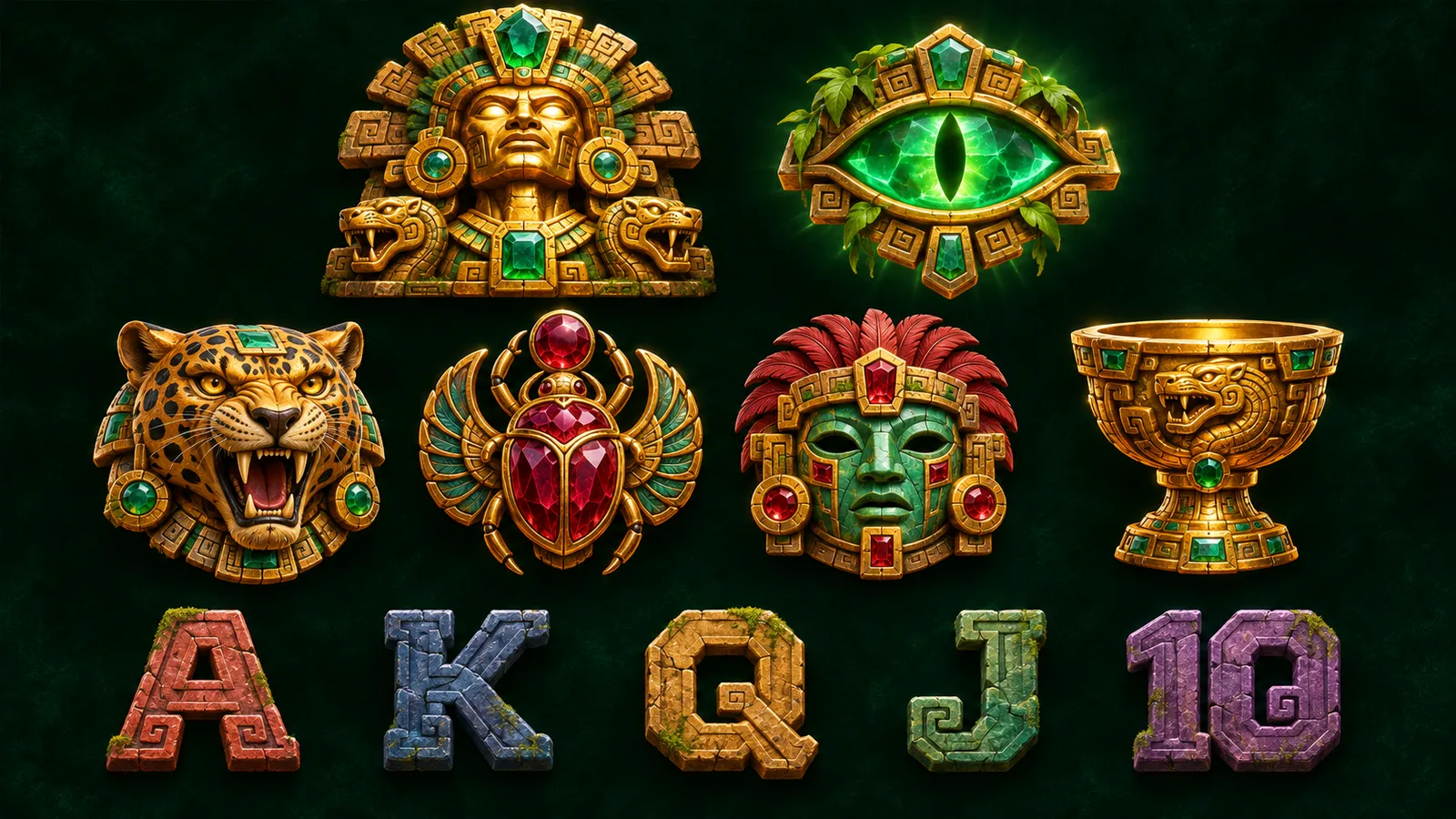
Whatever the theme, a slot runs the same small cast: a Wild, a Scatter, a few high pays, a row of low pays that are usually card ranks, and often the mascot on the reels. Pharaohs or pirates, the jobs stay put. Each job also decides how the symbol has to look, because the player reads it while it's moving.
The visual budgets behind the tiers (shape mass, fill, material depth) are in slot symbol tiers and paytable design. This page is about the roles.
The Wild
The Wild substitutes. It stands in for ordinary paying symbols so a line can complete. Rules vary a lot from game to game; in Starburst the Wild only lands on the middle three reels and expands to fill the whole reel. In the five-reel preview that every finished set opens as, lines read left to right. Wilds at the start of a line pay whichever symbol they run into, a line of only Wilds pays the Wild's own table, and the Wild never stands in for the Scatter.
It can sit inside any win, so it has to be recognised instantly. We draw it as a closed, solid, symmetrical mass, square to the viewer, with the deepest chamfer and brightest outside highlight in the set. It's also the first symbol generated. The finished Wild becomes the master that fixes the value range and detail level every later symbol is drawn against.
The Scatter
The Scatter is the bonus trigger. It doesn't need a line: it pays from anywhere in the window, and three of them start the bonus. Some games fold both jobs into one symbol, like the book in Book of Dead, which is Wild and Scatter at once. Most keep them separate.
In the preview it sits on reels one, three and five only. Put a Scatter on every reel and the bonus fires far too often. When three land, the stage cross-fades to its bonus background and the mascot holds its win pose.
The player has to spot a Scatter while the reels are still stopping, so it needs a different silhouette from the Wild. A different word printed across the same shape isn't enough. The classic mistake is a gold coin marked WILD and a gold coin marked BONUS: at speed, or in greyscale, they're the same coin. Here the Scatter is an open mass with one obvious hole through it, allowed to sit a little off-axis, cooler in colour, with its focal light coming from inside. Closed and lit from outside, next to pierced and glowing from within, stays distinct in motion.
High pays
The high-pay or premium symbols are the game's world on the reels: the characters, creatures and objects the theme is about. They pay more and land less. In the preview strips each high pay has three copies per reel against five for each low pay, and the first high pay is the top-value hero of the group.
Every one comes from words in the brief. Left blank, the high tier derives up to four subjects from the game name and theme; named outright, it holds up to eight. Each is one object on transparency, framed to 76% fill on a 512×512 canvas, with layered materials and a separately generated plaque behind it. The plaque is what makes the premiums read as one family without forcing a helmet and a winged horse into the same outline.
Low pays and card ranks
Low pays carry the reel. They land most, pay least, and give the eye somewhere quiet between premium hits. Card ranks are the convention: leave the low tier blank and you get A, K, Q and J, continuing through 10, 9, 8 and 7 if you ask for more. Plenty of games skip ranks entirely. Starburst's low pays are coloured gems. You can swap ranks for simple icons of your own, and a value entered as only a letter or number is rendered as exactly that glyph.
Low pays are plain on purpose: one material, at most one accent, no ornament, no plaque, 70% fill with a wider empty margin. A common mistake is giving the ranks gold trim and filigree because they looked flat in the mockup. Then the premiums have nowhere left to go. The plainness of the ranks is what makes a premium look premium.
The mascot on the reels
The mascot stands beside the cabinet, and the same character usually appears on the reels as a head-and-shoulders bust. It doesn't add a symbol. It takes a high-tier slot, which is why a planned mascot belongs first in the list of high-tier ideas.
Shrink a full figure into a reel cell and the face is gone. So the bust is cropped at the upper chest, faces the player and must read at 96 pixels. It's cut from the finished mascot, so both views share one face. The standing figure is covered in the mascot design guide.
How many symbols a set carries
| Role | Count in a set | What it does | How it reads |
|---|---|---|---|
| Wild | 1 | Substitutes on lines | Closed, symmetrical, lit from outside |
| Scatter | 1 | Pays anywhere, three start the bonus | Open, lit from within |
| High pay | Up to 4 derived, up to 8 on request | The world's subjects, higher pays | Layered materials, plaque, 76% fill |
| Low pay | 4 ranks by default, up to 8 | Frequent, small pays | One material, no plaque, 70% fill |
| Mascot bust | Takes one high slot | The game's face on the reels | Head and shoulders, readable at 96px |
So a default set is ten symbols. A thin theme that can't supply four distinct high pays gets a smaller set, never invented subjects. A brief whose words can't supply two drawable things for the Wild and Scatter gets asked for more words before anything is drawn.
Reading them at speed
Nobody sees pay values while the reels move. Each role has to announce itself through shape, scale, material and light. Three checks catch most problems:
- Shrink every symbol to a 96-pixel cell and name each one from its outline alone.
- Put the Wild and Scatter side by side. Closed against open, outside light against inside light.
- Compare one high pay with one rank. The high pay should be richer, and the rank should still be easy to read.
Then spin it. Motion merges detail that looked distinct on a still, which is why every finished set here opens as a playable five-reel game.
How Slot Art Generator draws them
Every symbol is one object on a transparent 512×512 canvas. Its prompt allows one subject and excludes the subjects of every other symbol, so the Wild's motif doesn't leak across the cast. Only the Wild and Scatter get the theme sentence; the high and low tiers get their own subject and nothing else. Faces, eyes and hands are banned unless a symbol is marked as a character, which stops a lantern from growing a face.
After generation, code removes the backdrop, reframes each subject to its tier's exact fill (80% for Wild and Scatter, 76% for high, 70% for low) and pulls colours toward the set's own palette. Plaques and effect layers ship as separate files, never baked in. To see the roles working together, open a set in the showcase, and read writing a slot art prompt before you name your own cast.
Questions
- What are the symbols on a slot machine?
- A small cast in fixed roles: a Wild, a Scatter, a few high-pay symbols from the game's world and a row of low-pay symbols, usually card ranks. Many games also put the mascot on the reels as one of the high pays.
- What does the Wild symbol do?
- It stands in for ordinary paying symbols to complete a line. In the preview here, Wilds at the start of a line pay whichever symbol they run into, a line of only Wilds pays the Wild's own table, and the Wild never stands in for the Scatter.
- What does the Scatter symbol do?
- It pays from anywhere in the window instead of along a line, and three of them start the bonus. In the preview here it lands on reels one, three and five only, and three Scatters relight the stage into its bonus state.
- How many symbols does a slot game have?
- A default set here has ten: a Wild, a Scatter, up to four high-tier subjects from the theme and four card ranks. Either tier goes up to eight when the brief names enough subjects.